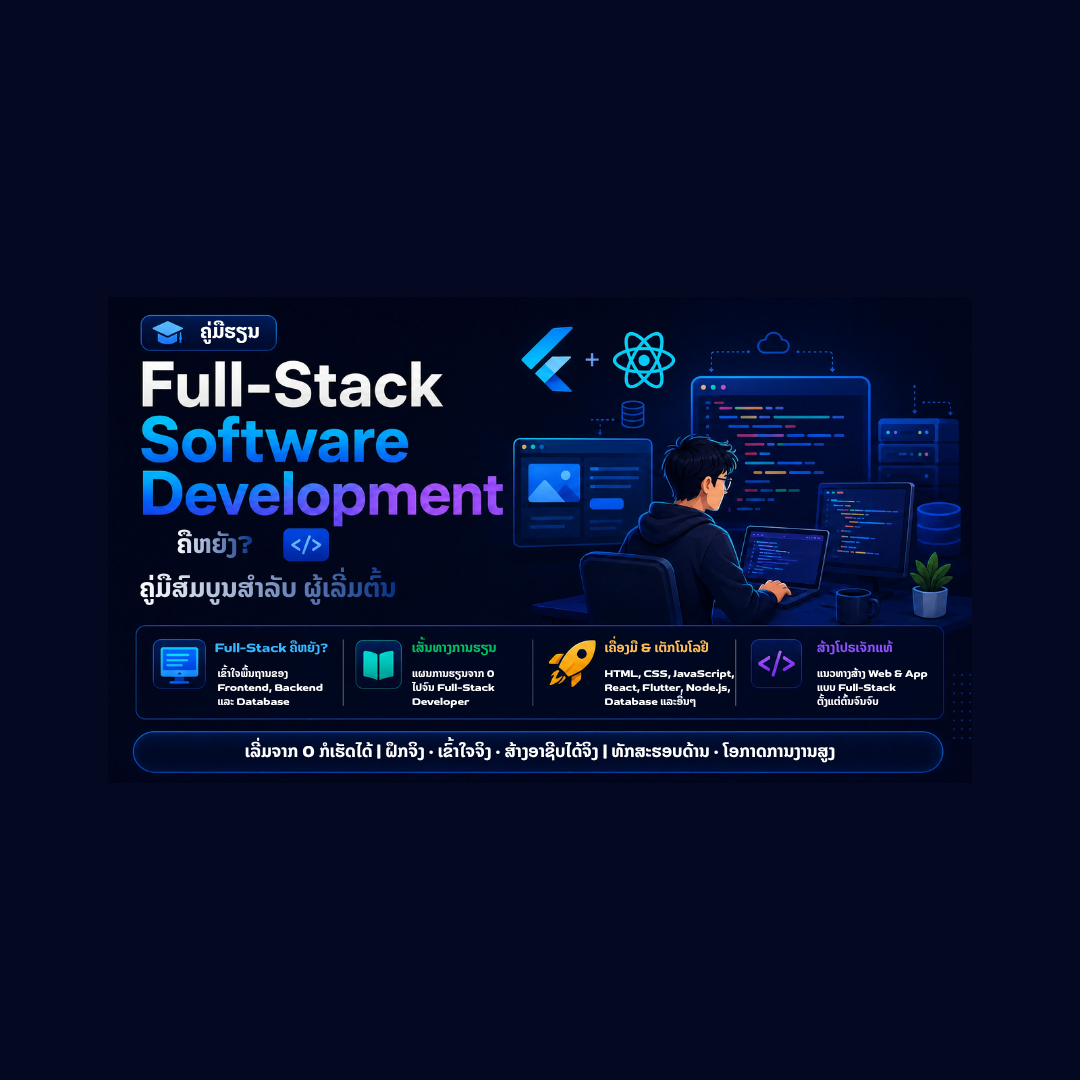
What is Full-Stack Software Development? A Complete Guide for Beginners
In the digital age where businesses of all sizes need Software systems to drive their operations, Full-Stack Developer has become one of the most in-demand careers in the market. This article will guide you to understand what Full-Stack Development is, what it consists of, and how to start learning.
What is Full-Stack Development?
Full-Stack Development refers to Software development that covers both sides:
- Frontend (Client-Side) — The part users see and interact with directly, such as: web pages, buttons, forms, images
- Backend (Server-Side) — Data management, business Logic, APIs, security maintenance
- Database — Storing and managing all data in the system
Simply put, a Full-Stack Developer is someone who builds everything — from the screen users see all the way to the Server working behind the scenes.
Structure of a Full-Stack Application
Every application has a core 3-layer structure (Three-Tier Architecture):
- Presentation Layer (Frontend) — The display layer that runs in the user's Browser
- Application Layer (Backend) — The Logic management layer that runs on the Server
- Data Layer (Database) — The layer that stores data permanently
Frontend Development — The Front End
Frontend is everything users can see and interact with. Core technologies you need to learn:
- HTML — Structure and content of web pages
- CSS — Styling, colors, Layout, Animation
- JavaScript — Interaction, Dynamic Content, API Calls
- Framework — React, Vue.js, Angular for faster development
Example: Simple React Component
// Create a Component to display a Product Card
  function ProductCard({ name, price, image }) {
    return (
      <div className="card">
        <img src={image} alt={name} />
        <h3>{name}</h3>
        <p className="price">{price} USD</p>
        <button onClick={() => addToCart(name)}>
          Add to Cart
        </button>
      </div>
    );
  }

  export default ProductCard;
Backend Development — The Back End
Backend is the "brain" of the Application that manages Logic, security, and data. Popular languages and frameworks:
- Python + Django / FastAPI — Easy, readable, great for AI/ML
- Node.js + Express — Uses the same JavaScript as the Frontend
- Java + Spring Boot — Suitable for large-scale Enterprise applications
- Go — Fast, highly Concurrent, ideal for Microservices
Example: REST API with Python FastAPI
from fastapi import FastAPI
  from pydantic import BaseModel

  app = FastAPI()

  class Product(BaseModel):
      name: str
      price: float
      stock: int

  # Product list
  products = []

  # GET — Fetch all products
  @app.get("/api/products")
  def get_products():
      return {"data": products, "total": len(products)}

  # POST — Add a new product
  @app.post("/api/products")
  def create_product(product: Product):
      products.append(product)
      return {"message": "Product added successfully", "product": product}
Database — Data Management
There are 2 main types of databases that every Full-Stack Developer must know:
1. Relational Database (SQL)
Stores data in interconnected tables, ideal for structured data such as: customer records, orders.
-- Create a users table
  CREATE TABLE users (
      id        INT PRIMARY KEY AUTO_INCREMENT,
      name      VARCHAR(100) NOT NULL,
      email     VARCHAR(100) UNIQUE NOT NULL,
      created_at DATETIME DEFAULT CURRENT_TIMESTAMP
  );

  -- Fetch users who registered in the last 30 days
  SELECT name, email
  FROM users
  WHERE created_at >= NOW() - INTERVAL 30 DAY
  ORDER BY created_at DESC;
2. NoSQL Database
Stores data in flexible formats such as JSON Documents, ideal for data with variable structure or real-time data.
// MongoDB — Fetch products with price
  below 500,000
  const products = await db.collection("products").find({
    price: { $lt: 500000 },
    inStock: true
  }).sort({ price: 1 }).toArray();

  console.log(`Found ${products.length} items`);
Popular Tech Stacks in 2025
A Stack refers to the combination of technologies used together across Frontend, Backend, and Database. Here are the stacks with the highest market demand:
- MERN Stack — MongoDB + Express + React + Node.js Great for Web Apps requiring Real-time features such as: Chat, Dashboards
- Django + React — Python/Django (Backend) + React (Frontend) + PostgreSQL Ideal for Apps requiring high Security such as: ERP systems, Finance
- T3 Stack — Next.js + TypeScript + tRPC + Prisma + PostgreSQL The most modern stack, fully Type-safe from Frontend to Database
- Laravel + Vue — PHP/Laravel (Backend) + Vue.js (Frontend) Widely used in SEA, comprehensive documentation, suitable for SMEs
DevOps and Deployment — Taking Software to Production
Software development doesn't stop at writing Code. Modern Full-Stack Developers must also understand DevOps:
- Version Control — Use Git to manage Code and collaborate as a team
- Containerization — Docker packages the App to run in any Environment
- CI/CD Pipeline — Automatically test and Deploy every time Code is pushed
- Cloud Platform — AWS, Google Cloud, Azure or DigitalOcean for Hosting
- Monitoring — Track Performance and Errors with Grafana, Sentry
Example: Dockerfile for a Django App
# Use Python 3.12 as the Base Image
  FROM python:3.12-slim

  WORKDIR /app

  # Install Dependencies
  COPY requirements.txt .
  RUN pip install --no-cache-dir -r requirements.txt

  # Copy all Code
  COPY . .

  # Expose Port 8000
  EXPOSE 8000

  # Start the Server
  CMD ["gunicorn", "core.wsgi:application", "--bind", "0.0.0.0:8000"]
Full-Stack Development Learning Path
If you want to become a Full-Stack Developer, here is the recommended path:
- Web Fundamentals (1–2 months) — Basic HTML, CSS, JavaScript
- Frontend Framework (2–3 months) — Build a solid foundation in React or Vue.js
- Backend and Database (2–3 months) — Python + Django/FastAPI + SQL
- API and Authentication (1 month) — REST API, JWT, OAuth2
- Basic DevOps (1 month) — Git, Docker, Cloud Deployment
- Build Real Projects (ongoing) — Experience from real projects is worth far more than any Certificate
Summary
— Build a solid foundation in React or Vue.js
- Backend and Database (2–3 months) — Python + Django/FastAPI + SQL
- API and Authentication (1 month) — REST API, JWT, OAuth2
- Basic DevOps (1 month) — Git, Docker, Cloud Deployment
- Build Real Projects (ongoing) — Experience from real projects is worth far more than any Certificate
Full-Stack Development is a skill that demands patience and continuous learning. Nobody knows everything right away — the best developers are those who know what to Google.
Most importantly, get your hands dirty with real projects — build a Website, an API, or your own Mobile App. The experience gained from solving real problems will sharpen your skills far faster than reading hundreds of tutorials.
Do you have questions or need a more detailed Roadmap? Contact the Ainsteinx team anytime — we're always happy to help guide you toward your goals.